The ideal bathroom faucet is supposed to provide a perfect blend of efficiency, suitability, longevity, and design. But how do you get that perfect bathroom faucet for yourself? First of all, consider your basin type, your installation needs, and water pressure.
In Indian homes, concerns such as overhead tank pressure, hard water, and maintenance might prove to be highly effective in determining the efficiency and longevity of the faucet. The ideal faucet should be efficient enough to provide adequate water flow along with suitability to the basin. With consideration of all these factors and many more, you can select a highly efficient faucet for your bathroom.
What Factors Should You Consider Before Choosing a Bathroom Faucet?
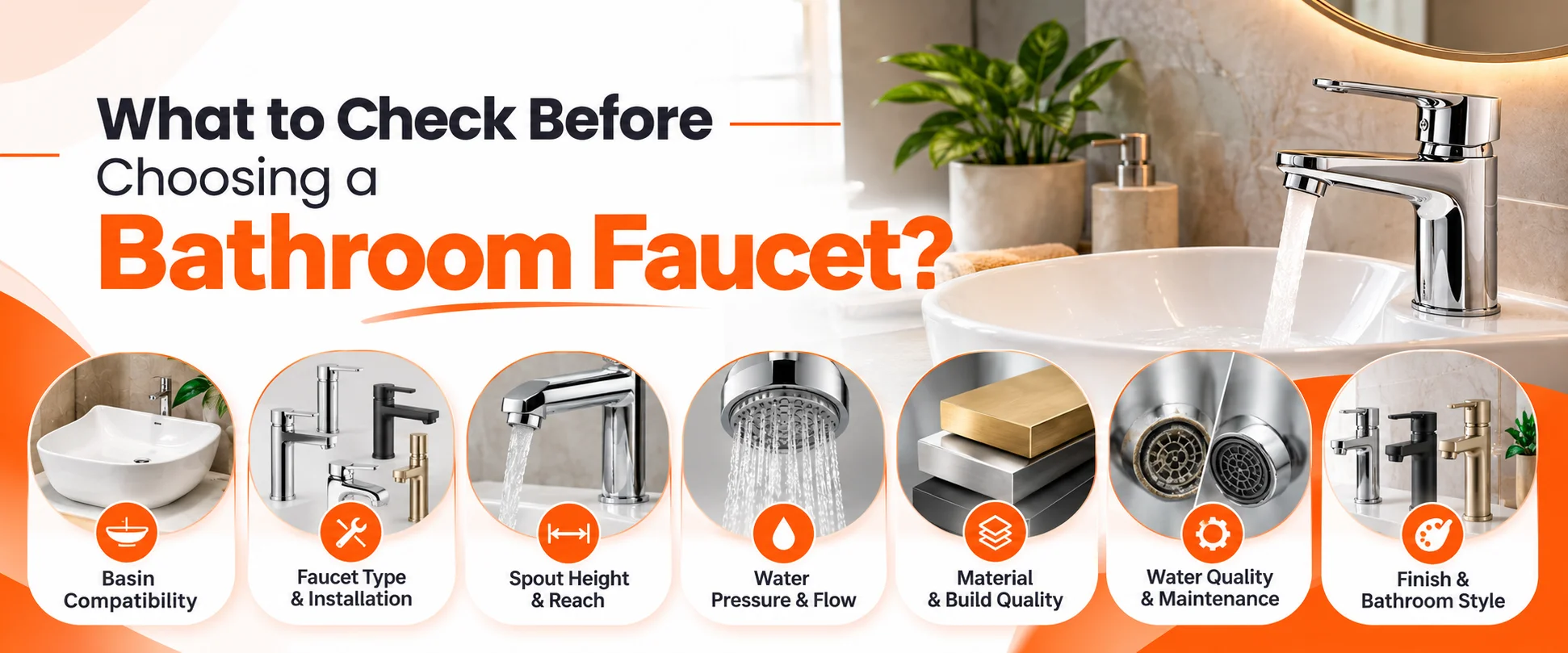
Before purchasing a faucet, understanding the things to consider when buying bathroom fittings can help you evaluate the basin type, installation method, spout size, water pressure, material and local water conditions. This will help you avoid some typical pitfalls.
1. Basin Type and Faucet Compatibility
Make sure you choose the faucet that suits the installation type and size of your washbasin. Confirm if there is a tap hole in the basin or whether it requires a countertop or wall-mounted faucet.
In case your washbasin sits above the counter, it may need a tall faucet or wall-mounted faucet installed properly, and a basin with tap holes will be best suited to the deck-mounted faucet.
2. Faucet Type and Installation
It is important for the kind of faucet to suit the existing plumbing system of your bathroom or the one that you wish to install in your bathroom. Basin faucets require mounting fixtures, while mixers need proper water connections.
Choosing the faucet comes first before plumbing points are chosen in a remodeling project. In addition, one should examine the installation requirements since faucets that look the same still may have different requirements.
3. Spout Height and Reach
Selecting the appropriate height and extent of the spout enables effortless deposit of water in the basin without hindering the cleaning process.
A small spout would be limited when it comes to handwashing space, while an extremely long faucet over a small basin increases the possibility of splashing. The spout should be able to extend far enough into the bowl but not too close to the rim. Do compare the size of your basin with that of the faucet.
4. Water Pressure and Flow
Select a faucet that works well according to the water pressure at home. Water pressure in Indian homes varies according to the height of the overhead tank and even as per the floor level where the faucet is located.
It is no use getting a large-size faucet when the flow is already low because this is not necessarily going to increase the flow; you should select the faucet based on its operating pressure range.
5. Faucet Material and Build Quality
Check the faucet’s construction and internal components instead of judging quality by appearance alone. Brass and stainless steel are commonly used, but material is only one consideration.
Also evaluate the cartridge or valve, surface coating, ease of operation, warranty and availability of compatible replacement components. These factors can influence how conveniently the faucet can be used and serviced over time.
6. Water Conditions and Maintenance
If your home has hard water or frequent mineral deposits, prioritise a faucet that is easy to clean and maintain.
Mineral buildup commonly appears around areas where water dries, including the spout and aerator. Look for an accessible aerator, surfaces that can be cleaned according to manufacturer instructions and readily available replacement parts.
Remember that a faucet finish may make mineral marks more or less visible, but it does not prevent hard-water deposits.
7. Faucet Finish and Bathroom Design
Choose the finish only after confirming that the faucet meets your functional requirements. Chrome is versatile and reflective, while brushed or satin finishes provide a softer appearance and can make some everyday marks less noticeable. Matte black creates stronger contrast, whereas gold and gunmetal can act as statement finishes.
Coordinate the faucet with visible bathroom elements such as shower fittings, health faucets, handles, mirrors and bathroom accessories. They do not need to match perfectly, but the combination should look intentional.
What Bathroom Faucet Features Are Worth Considering?
The most useful faucet features are those that improve water control, everyday operation or maintenance. Avoid choosing extra features simply because they sound premium.
- An aerator can help create a more controlled water stream and reduce unnecessary splashing when appropriately designed for the faucet. Because deposits can collect around the outlet, also check whether the aerator can be maintained conveniently.
- The cartridge or valve controls water flow and, in mixers, helps manage temperature. Look for smooth operation and check whether compatible replacements are available.
- A single-lever faucet can make everyday flow and temperature adjustment convenient where the plumbing supports it.
For faucets marketed with water-saving or flow-control features, check the actual product specifications and make sure the resulting flow is appropriate for your water pressure and usage requirements.
Which Type of Bathroom Faucet Is Right for Your Basin?
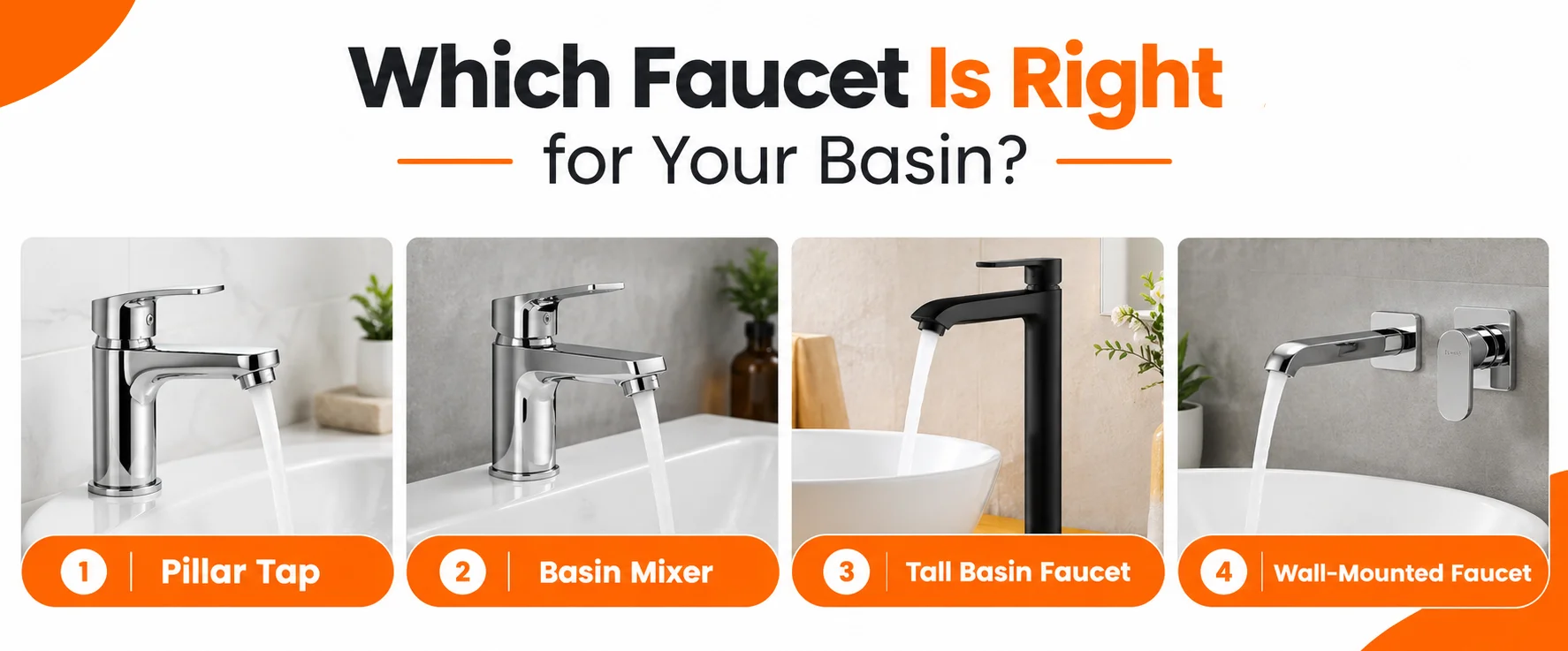
The right bathroom faucet type depends primarily on your basin design, mounting provision, plumbing arrangement and whether you need hot and cold water mixing.
1. Pillar Tap
Choose a pillar tap when you have a compatible basin and want a straightforward faucet arrangement. Pillar taps are commonly used with basins that provide a suitable mounting hole. Depending on the setup, separate taps may be used for different water supplies.
They can be practical where the plumbing is simple and temperature mixing through a single outlet is not required.
2. Basin Mixer
Choose a basin mixer when you have hot and cold water connections and want to control both through a common outlet. A mixer can make temperature adjustment more convenient and provide a cleaner basin arrangement than separate hot and cold outlets.
Before choosing one, confirm that the plumbing connections, mounting arrangement and available water pressure meet the product’s requirements.
3. Tall Basin Faucet
Choose a tall basin faucet primarily for an above-counter or vessel basin that requires additional faucet height. The extra height allows the spout to clear the raised basin edge. However, taller is not automatically better.
Check the basin height, faucet reach and expected water stream together. An unsuitable combination can cause water to hit the bowl at an awkward point and increase splashing.
4. Wall-Mounted Faucet
Choose a wall-mounted faucet when your bathroom plumbing is designed for wall installation and you want to keep the basin or countertop free of the faucet body. It can work particularly well with countertop basins and minimalist bathroom designs.
The main consideration is installation accuracy. The faucet height and projection need to work with the basin and the plumbing position should ideally be planned before the finished wall surface is completed.